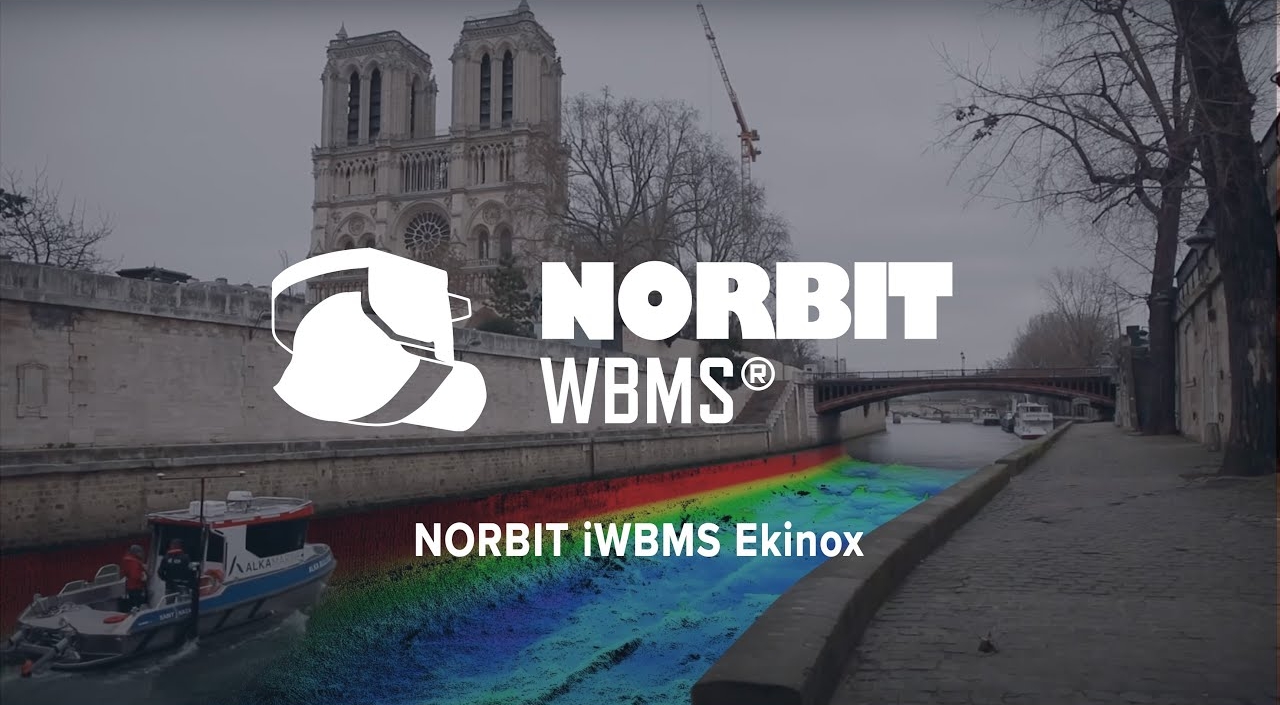

Introduction
NORBIT has launched the iWBMS Ekinox product in partnership with SBG Systems, featuring a WBMS sonar with integrated SBG Navsight Ekinox inertial navigation system.
- Frequency agile 200-700kHz.
- 0.5 x 0.5°beam width resolution at 700kHz.
- Up to 210°swath width (single head) as standard.
- HD beamformer providing 512 beams per ping with 1024 HDS option.
- High performance integrated Navsight Ekinox GNSS/INS system.
- Integrated sound velocity probe.
- Small form factor and low power consumption.
- Designed for rapid mobilisation on any platform.
- Bathymetry and various backscatter and water column data as standard deliverables.
- Optional integrated LiDAR.

Installation
Performance trials were conducted in Paris, France. The iWBMS Ekinox and iLiDAR were mounted on a vessel of opportunity and configured for operation in less than 1 hour.
The sonar and integrated INS interface to the compact topside unit via a single deck cable.
All sensors were mounted on a small boat using the NORBIT PORTUS pole, a lightweight, portable carbon fibre solution that was specifically designed for NORBIT systems.


Data Collection
14km of the Seine River was mapped in less than 2 days, and the resulting 0.25m DTM was overlaid on aerial imagery.
The high resolution bathymetry data shows small geological features on the riverbed.
In the narrow sections of the river, it was possible to achieve full data coverage on both sides up to waterline in a single pass using NORBIT’s 210°wide swath capability.
RTK GNSS corrections were interfaced to the system in real time, providing centimeter positioning accuracy. The raw navigation data was logged and post-processed in Qinertia to improve the navigation solution under bridges where satellite coverage was not optimal. The PPK solution output from Qinertia was applied to bathymetry data in the post-processing software.

RTK GNSS corrections were interfaced to the system in real time, providing centimetre positioning accuracy.
The raw navigation data was logged and post-processed in Qinertia to improve the navigation solution under bridges where satellite coverage was not optimal.
The PPK solution output from Qinertia was applied to bathymetry data in the post-processing software.

Results
The survey of the Seine River demonstrated the full capability of the NORBIT iWBMS Ekinox system for combined bathymetric and LiDAR mapping in a complex urban environment.
The high resolution bathymetry data shows small geological features on the riverbed. A 0.25 m digital terrain model (DTM) was generated and overlaid with aerial imagery, showing both geological and man-made features clearly.
Statue de la Liberté Paris
The Statue of Liberty replica, given to the city in 1889, was surveyed with the multibeam and LiDAR simultaneously. The system generates a full georeferenced point cloud, above and below waterline, in real time.

Bridge Inspection
Many bridges were surveyed, showing accuracy of elements above water level. This is a survey of Pont de la Concorde arch bridge.

Pont d’lena
This image shows the point cloud data from the multibeam and LiDAR around the Eiffel Tower in central Paris. The Eiffel Tower 3D model was added later for context.

Quay Wall Inspection
Quay Walls were surveyed with a seamless transition between the multibeam and LiDAR data.

Object detection
The sonar detected small features on the riverbed, including a 0.5 m (Ø 20 in) gas pipeline. This demonstrates the iWBMS Ekinox system’s fine-scale target resolution and positional accuracy.

Conclusions
The NORBIT iWBMS Ekinox offers a high-accuracy GNSS/INS solution coupled with NORBIT's high-resolution WBMS to existing SBG users, and as an alternative system for NORBIT iWBMS users.
– The sonar with SBG Ekinox GNSS/INS embedded into the unit ensures fast and reliable mobilisation and the highest quality sounding data in all conditions.
– The tight integration of the GNSS/INS subsystem minimises cables and error sources compared to traditional setups with standalone sensors.
– NORBIT’s curved array technology allows the beams to be steered electronically up to waterline without having to physically rotate the sonar, which is ideal for combined multibeam and LiDAR surveys, allowing seamless transition between the two data types.