
Introduction
Multibeam echosounders (MBES) are commonly used for mapping the seabed. However, these data also allow for bottom classification and benthic habitat mapping.
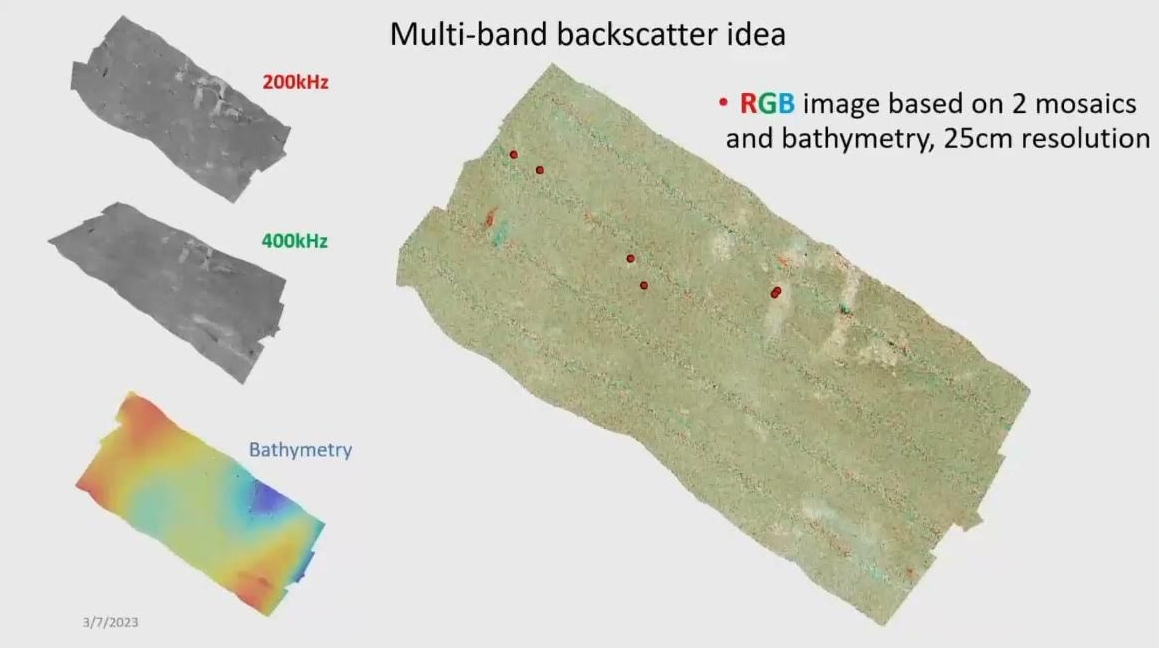
Modern MBES systems also record the reflectivity of the seabed, which is an indicator of its physical properties. This reflectivity, known as backscatter, can be measured at different frequencies, resulting in multi-spectral backscatter.
Some MBES systems even come with calibrated backscatter, which is an absolute measure of acoustic reflectivity. This calibrated backscatter can be compared with physical models to classify different bottom types and understand the morphology of the seabed.
This study explores how these advancements can enhance bottom classification procedures and highlights their benefits.
Video presentation
Aleksandra Kruss. Scientific Survey NORBIT Poland, Sopot, Poland.
aleksandra.kruss@norbit.com.
Pawel Pocwiardowski. NORBIT Poland, Sopot Poland.
Arthur Grzadziel. Dept. of Navigation and Hydrography. Polish Naval Academy, Gdynia, Poland.
Mariusz Waz. Dept. of Navigation and Hydrography. Polish Naval Academy, Gdynia, Poland.
Dept. of Geophysics, Faculty of Oceanography and Geography, University of Gdansk, Gdansk, Poland.