
Introduction
The natural gas hydrate (NGH) distribution and stability can be assessed by indirect hydrates indicators (geophysical attributes to the presence of gas or seepage).
Modelling results suggest favourable thermobaric conditions for the formation of NGHs in the fjords of the Svalbard archipelago. However, near-shore NGH potential is poorly constrained.
Estimating and understanding the NGHs distribution and stability in shallow areas is crucial to:
- Assess the hydrate-related resource potential.
- Mitigate hydrate-related geohazards such as submarine landslides.
- Constrain uncertainties in future climate scenarios. NGH dissociation could result in positive feedbacks enhancing polar amplification and global warming.

Gas seepage are recordable prospecting indicators of near-bottom agglomerations of natural gas hydrates (NGH).
Gas emissions in the water column can be recorded and visualized using hydroacoustic echosounders.
They appear in echograms as vertical anomalies, commonly called flares.

The Study
The field campaign has been designed to acquire valuable high-resolution hydrographic and bathymetric data from the shallow areas of the fjords in order to infer the fluid flow characteristics. Also, to explore new gas flares and indirect seabed hydrate indicators in Isfjorden’s seafloor morphology.
The work has been conducted in the frame of the GASGEM cruise 2021, a collaboration between the University Center in Svalbard and the University of Bremen with the support of the Research Council of Norway via the Arctic Field Grant 2021.

Study Goals
Characterize and classify the gas flares identified in hydrographic profiles from the shallow waters of the Svalbard archipelago.
- Evaluate the spatial distribution of the gas flares detected in the water column in Isfjorden and its tributary fjords.
- Correlate the seepage with the fjord’s geological setting and evaluate its origin.
- Add relevant information to assess the presence of near-shore natural gas hydrates (NGH) in the fjords of Svalbard.

Method
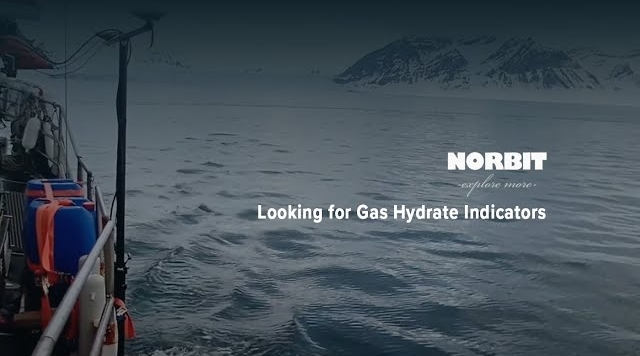
The survey was conducted from the Czech Arctic Research Station’s vessel, RV Clione.
- We used a NORBIT iWBMSh high-end turnkey multibeam sonar system.
- The multibeam was mounted on the NORBIT carbon fiber “Portus” mounting pole with a high telescopic mast (1,7 m) for the GPS antennas.
- The multibeam operated at 200-400 kHz with an equiangular mode, with a maximum swath angle of 120° in shallow areas and 90° in deeper waters for an optimal depth range of 10-250 m.
- Sixteen Sound Velocity Profiles (SVPs) were performed along the transects.
- NORBIT’s DCT software was used for data acquisition.

Set up of the NORBIT iWBMSh Multibeam Sonar System

Over 110 km2 were surveyed in the inner part of Isfjorden and tributary fjords of Tempelfjorden, Sassenfjorden, Billefjorden and Nordfjorden.

Data and Results
Seafloor morphology
Bathymetric data example with water column curtain

Hydroacoustic profiles
Tens of hydroacoustic anomalies interpreted as gas flares have been identified in the echograms on the water column.

Hydrographic profiles processing with FM Midwater module of Fledermaus (©QPS) for flares detection in the water column.

Conclusions
The hydrographic profiles acquired with a NORBIT iWBMSh system have allowed the characterization of acoustic anomalies in the water column identified as gas flares.
The outcome of this study facilitates further investigation of observed phenomena responding to the presence of NGH by comparing the gas hydrate stability zone (GHSZ) thermodynamic requirements with the direct and indirect hydrate indicators.
This study will contribute valuable scientific data and complement previous studies to better understand the potential NGH distribution in shallow-water areas in the Arctic.
Summary
Working in collaboration with NORBIT has been a fantastic experience:
- Easy and quick installation of the equipment.
- Straightforward software setup.
- Good data acquisition for water column imaging.
- Excellent support team.
The research team would like to thank NORBIT Subsea for supporting us with a high-resolution multibeam system, which helped us acquire crucial data for the development of our study.
For further information about the study,
contact: NilRodes (nilrodes@yahoo.com)